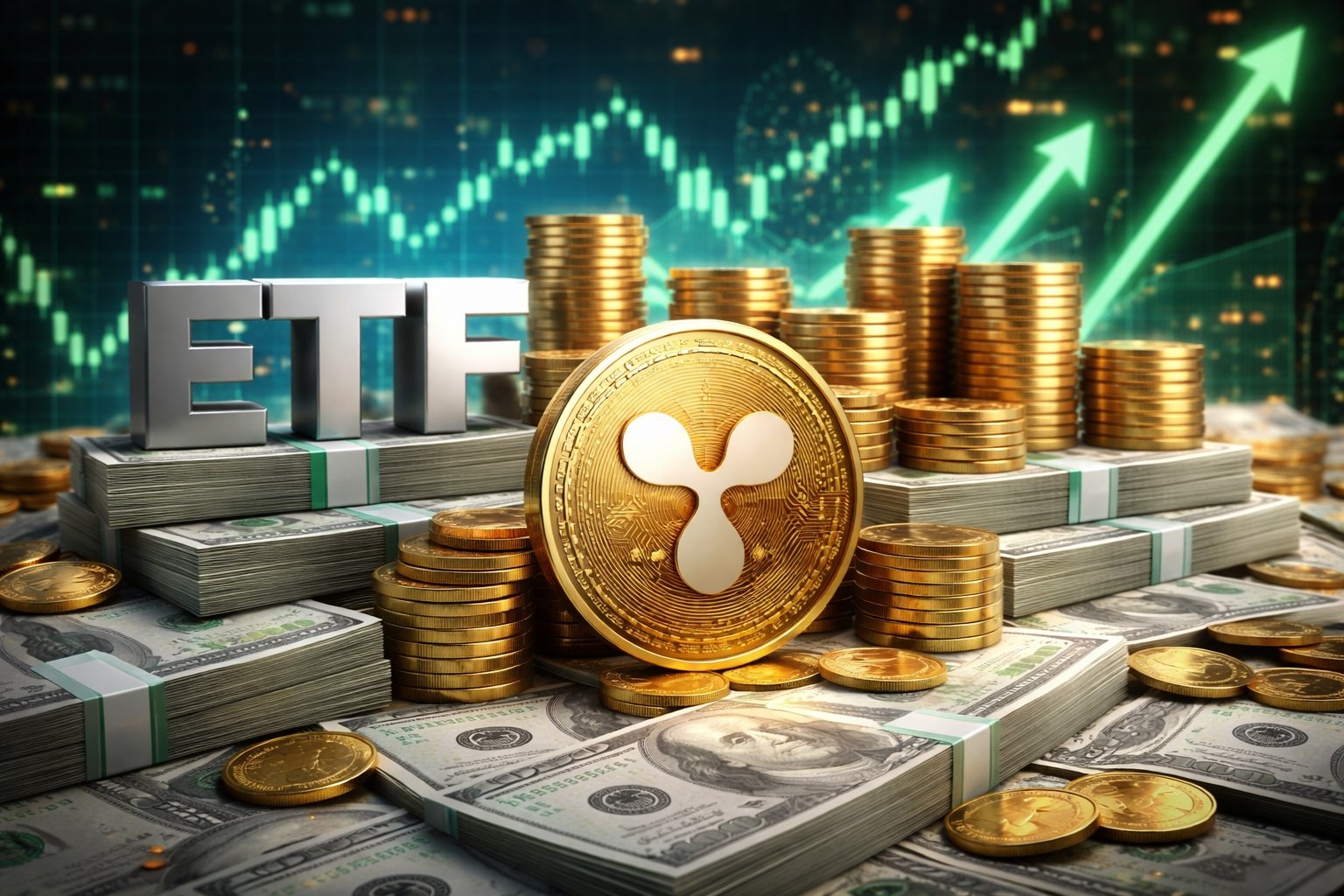

XRP exchange-traded funds crossed $1.2 billion in assets under management faster than any crypto ETF since Ethereum launched. Yet the token trades 60% below its 2025 peak. The billion-dollar figure sounds impressive until you compare it to what’s needed to actually move price, understand who’s been selling, and recognize where institutional demand would need to reach before supply constraints kick in.
Current State of XRP ETFs in March 2026
The $1.2 Billion Milestone in Context
Six spot XRP ETFs launched between November 2025 and January 2026. Total assets under management reached $1.24 billion as of March 18, 2026, with approximately 810 million XRP tokens locked in custody. The funds went 43 consecutive trading days without a single net outflow, a streak even Bitcoin and Ethereum ETFs couldn’t match.
That $1.2 billion represents roughly 1.3% of XRP’s total circulating supply of 61.1 billion tokens. Bitcoin ETFs, by contrast, hold over 6% of BTC supply, and that concentration was a primary driver behind Bitcoin’s 2024 rally.
The difference matters. At 1.3%, XRP’s ETF footprint isn’t large enough to move price through supply constraint alone. It removes tokens from circulation, yes, but not at the scale needed to create the squeeze that holders have been anticipating.
Which XRP ETFs Are Available
Franklin Templeton (XRPZ) carries the lowest expense ratio at 0.19%, currently waived through May 2026. Bitwise, Canary Capital, Grayscale, 21Shares, and Rex Osprey round out the product lineup, with fees ranging from 0.30% to 0.75%.
The competitive fee structure reflects institutional confidence. When asset managers like Franklin Templeton and Grayscale launch products, they’re betting on sustained demand, not a short-term retail pump. These aren’t speculative ventures. They’re portfolio allocations designed for investors who want XRP exposure without touching a crypto exchange.
Every major issuer that launched a Bitcoin or Ethereum ETF now offers an XRP product. That’s institutional validation, even if the price action hasn’t reflected it yet.
Why $1.2 Billion Hasn’t Moved the Price
Institutional Buying Meets Whale Distribution
Since early January 2026, approximately 3.8 billion XRP flowed from whale wallets onto Binance. In late February alone, 472 million XRP hit exchanges in a single week, valued at roughly $660 million. That single wave of selling absorbed months of ETF accumulation.
Whales hold roughly 48 billion XRP, about 70% of total supply. Their buying and selling decisions move markets far more than retail flows or even institutional ETF demand. Since XRP’s $3.65 peak in July 2025, whales have cashed out an estimated $6 billion.
Institutions allocating to XRP ETFs are making portfolio decisions with six-month to multi-year horizons. They build floors under price by removing supply from circulation, but they don’t generate the sharp buying bursts that drive rallies. Whales liquidating positions create immediate downward pressure that overwhelms gradual institutional accumulation.
Exchange balances tell the story. They dropped 55% from October 2025 through early 2026, which analysts pointed to as bullish. Then the trend reversed. Binance reserves started ticking back up in February, meaning more XRP became available to sell. The popular “supply squeeze” narrative breaks down when whale distribution outpaces institutional buying.
The Correlation Problem
XRP tracks Bitcoin with a 0.84 correlation and amplifies BTC moves by approximately 1.8x. When Bitcoin tested $60,000 in early February 2026, XRP dropped to $1.11. When BTC climbed above $73,000 in mid-March, XRP rallied to $1.52.
ETF inflows provide long-term structural support, but Bitcoin’s price action dictates short-term direction. Until BTC stabilizes above $75,000 and pushes toward $100,000, altcoin rotation remains limited regardless of ETF demand.
This is why the disconnect between billion-dollar inflows and falling prices isn’t actually a contradiction. Institutional money builds a foundation. It doesn’t fight the macro trend when Bitcoin’s struggling and whales are selling.
The Critical Thresholds That Actually Matter
$3 Billion: The BlackRock Trigger
Canary Capital CEO Steven McClurg stated publicly that BlackRock would likely consider filing an XRP ETF once existing products cross $3 billion in assets. A BlackRock entry carries institutional credibility that no other issuer can match. Its Bitcoin ETF alone accumulated $54 billion in assets and reshaped how traditional finance approaches crypto exposure.
At $3 billion in total ETF assets, funds would hold approximately 2.1 billion XRP at current prices, representing roughly 3.4% of circulating supply. That’s still below Bitcoin ETF concentration levels but enough to signal sustained institutional interest beyond the initial launch phase.
BlackRock’s involvement would pull in institutional allocators who’ve been waiting for a tier-one issuer before committing capital. It’s not just about the assets BlackRock itself would gather. It’s about the signal that sends to pension funds, endowments, and family offices that have strict vendor approval processes.
$5 Billion: The Supply Squeeze Threshold
At $5 billion, XRP ETFs would control approximately 3.5 billion tokens at current price levels. That’s more XRP than currently sits on all centralized exchanges combined.
Exchange balances dropped 57% since October 2025, falling from roughly 4 billion XRP to 1.6-1.7 billion. ETFs holding more than exchange supply creates a structural imbalance where new buyers compete for a shrinking pool of available tokens. Order books thin out, bid-ask spreads widen, and modest buying pressure generates outsized price movements.
This isn’t speculation. It’s supply-demand mechanics playing out in real-time market structure. When available supply drops below a certain threshold relative to daily trading volume, price becomes more volatile and responsive to incremental demand. That’s the squeeze investors have been waiting for.
What works in favor of this thesis is that accumulation at lower prices locks up more supply per dollar. At $1.40 per XRP, every $1 billion in new ETF assets removes about 714 million tokens from the tradable float, compared to just 500 million at $2.00. The math gets more favorable for holders the longer price stays suppressed.
Timeline to Reach These Thresholds
Current ETF inflow pace averages $7-10 million per day. At that rate, reaching $5 billion from the current $1.24 billion would take well into 2027.
Two developments compress that timeline dramatically. First, a BlackRock filing would pull institutional allocators who’ve been waiting for a tier-one issuer. Second, Federal Reserve rate cuts—two to three expected through 2026—reduce the opportunity cost of holding non-yielding assets like crypto, which is part of why Bitcoin ETFs saw such aggressive institutional adoption in 2024.
If the Fed delivers the expected cuts and BlackRock files once assets hit $3 billion, the path to $5 billion could shorten to late 2026. That’s still months away, but far faster than the multi-year timeline current flow rates suggest.
What $8-10 Billion in ETF Inflows Would Actually Do
The AI Model Projections
ChatGPT forecasts XRP reaching $6-$8 if ETFs hit $10 billion, assuming those inflows remove roughly 7% of circulating supply. Claude AI projects $8-$14 under the same scenario, citing a self-reinforcing cycle where rising prices attract additional institutional interest.
Traditional analysts target $5-$6, acknowledging that $10 billion in ETF demand would stabilize price and create a floor near $2.50-$3.00, but noting that sustained appreciation above $5 requires broader adoption of Ripple’s On-Demand Liquidity product, which actually uses XRP for settlement.
The range of predictions reflects different assumptions about how markets respond to supply constraints. Conservative models assume profit-taking and whale distribution continue to offset institutional buying. Aggressive models assume a feedback loop where institutional confidence builds on itself.
The Multiplier Effect Nobody Talks About
Capital inflows into crypto markets don’t translate 1:1 into market cap increases. Historical data shows multiplier effects ranging from 50x to 300x depending on liquidity conditions.
In May 2025, $61 million in net inflows generated a $16.6 billion increase in XRP market cap, representing a 272x multiplier. Even using a conservative 70x multiplier, $12.3 billion in ETF inflows—equivalent to 5% of total supply at current prices—would add $861 billion to market cap, pushing XRP’s valuation to $1.01 trillion and price to approximately $16.85 per token.
These projections assume market conditions similar to previous bull cycles. Macro headwinds, sustained whale distribution, or Bitcoin breakdown would invalidate the multiplier thesis entirely. The 70x multiplier is conservative compared to historical peaks, but it still requires favorable conditions to materialize.
The mechanism works like this: every dollar entering through ETFs removes supply from circulation, which forces remaining buyers to bid higher. As price rises, momentum traders enter, amplifying the move. The multiplier isn’t magic. It’s the compounding effect of constrained supply meeting increased demand in a market where most holders aren’t actively selling.
The Institutional Adoption Piece Most Articles Miss
Ripple Prime and NSCC Integration
In April 2025, Ripple acquired Hidden Road Partners for $1.25 billion and rebranded it as Ripple Prime. In early 2026, Hidden Road was added to the National Securities Clearing Corporation’s Market Participant Identifiers directory.
The NSCC is a DTCC subsidiary handling clearing, settlement, and risk management for broker-to-broker trades in U.S. financial markets. This isn’t a marketing announcement. It means Ripple Prime is integrated into the actual plumbing of U.S. institutional financial infrastructure—the same system processing trillions of dollars in securities transactions daily.
Ripple has stated that Ripple Prime’s post-trade activity will eventually connect with the XRP Ledger. If that integration enables institutions to settle trades using XRP as working capital within the NSCC framework, it creates functional demand entirely separate from speculative ETF flows.
This is the type of demand that builds slowly but compounds over time. It’s not traders chasing momentum. It’s institutions holding XRP because they need it to participate in a settlement network. That demand is sticky, recurring, and tied to transaction volume rather than price speculation.
RWA Tokenization on XRP Ledger
The XRP Ledger currently hosts approximately $2.3 billion in tokenized real-world assets. Every dollar of tokenized assets settling or moving on XRPL creates demand for XRP that isn’t speculative or ETF-driven.
Institutions holding XRP as operational working capital to participate in the settlement network represent a fundamentally different demand profile than retail traders chasing price momentum or institutional allocators building passive crypto exposure through ETFs.
Real-world asset tokenization is where blockchain adoption moves from concept to infrastructure. When assets settle on-chain, the native token becomes a necessary operational tool, not an optional investment. That creates baseline demand that exists regardless of market sentiment or price action.
What Actually Needs to Happen for XRP to Break Higher
The Three-Part Catalyst Framework
First, Bitcoin needs to hold above $75,000 and push toward $100,000. Altcoin rotation doesn’t happen while BTC consolidates or declines. XRP’s 0.84 correlation with Bitcoin means macro crypto market direction sets the ceiling for any individual token’s performance.
Historical patterns show that capital flows into large-cap alts like XRP only after Bitcoin establishes a clear uptrend. When BTC rallied above $100,000 in mid-2025, XRP ran to $3.65. When Bitcoin tested $60,000 in early 2026, XRP dropped to $1.11. The relationship is consistent and predictable.
Second, ETF inflows need to reach the $3-5 billion range where BlackRock potentially enters and supply constraints start binding. Current pace puts that timeline in late 2026 or early 2027 unless Fed rate cuts or a major institutional announcement accelerates flows.
Third, at least one major bank needs to adopt On-Demand Liquidity for actual settlement, not just Ripple’s messaging infrastructure. Over 300 banks use RippleNet, but only about 40% use ODL where XRP moves as a bridge asset. Deutsche Bank’s February 2026 integration uses Ripple’s rails without touching XRP, which doesn’t create token demand.
All three need to align. Bitcoin above $100,000 creates the macro environment. ETF inflows hitting critical mass removes supply. Bank adoption of ODL creates recurring fundamental demand. Without all three, XRP stays range-bound.
The Downside Scenario
If Bitcoin breaks below $60,000 and stays there, XRP likely tests $1.00 or lower regardless of ETF flows. If whale distribution continues at the current pace, selling pressure overwhelms institutional accumulation. If ETF inflows stall before reaching critical mass, the supply squeeze thesis breaks down.
Institutional demand builds floors, not ceilings. XRP needs catalysts beyond passive ETF accumulation to break out of the $1.30-$2.00 range it’s traded in for months.
The risk isn’t that ETFs fail. It’s that they succeed at removing supply while macro conditions prevent price from responding. Institutions could lock up 2 billion XRP in ETFs while whales dump 4 billion onto exchanges. The net effect would be continued downward pressure despite institutional validation.
The Realistic 2026 Price Path
Conservative Base Case
Standard Chartered projects $2.80 by year-end 2026, representing a 100% gain from current levels. That assumes steady ETF accumulation, no major whale distribution events, Bitcoin stabilizing above $70,000, and gradual progress on bank adoption.
A 100% return in 12 months is what the stock market takes roughly a decade to deliver. For crypto, it’s a conservative forecast. It assumes no major catalysts fire but conditions remain favorable enough for institutional flows to continue.
The $2.80 target implies XRP recaptures some of the ground lost since the July 2025 peak without requiring a full bull market resumption. It’s achievable if the current trajectory holds and nothing breaks badly.
Bull Case Requires Everything Working
The $5-$8 range requires Bitcoin breaking $100,000, ETF inflows hitting $5 billion, sustained institutional demand, and macro conditions that don’t punish risk assets. Getting there means every variable aligns simultaneously.
Analysts acknowledge that setup is possible but unlikely. The path from $1.40 to $5 requires far more than just billion-dollar ETF inflows. It requires Bitcoin strength, whale accumulation instead of distribution, Fed rate cuts, BlackRock entry, major bank ODL adoption, and favorable regulatory developments all happening within the same 12-month window.
Standard Chartered’s longer-term projections show $7 by 2027, $12.60 by 2028, $19.60 by 2029, and $28 by 2030. At $28, XRP’s market cap reaches $1.7 trillion, which is Bitcoin’s territory today and implies a roughly 1,900% return from $1.40. Those numbers assume Ripple keeps expanding banking partnerships and cross-border payment volumes grow consistently over multiple years.
XRP ETFs crossed $1.2 billion faster than any crypto product since Ethereum, but that milestone alone doesn’t guarantee price appreciation. The critical thresholds are $3 billion (BlackRock trigger) and $5 billion (supply squeeze), and reaching either requires sustained inflows over months while Bitcoin holds above $75,000 and whale selling subsides. Until those conditions align, institutional demand builds a floor, not a launch pad.
Tom Sterling | GalaxCrypto