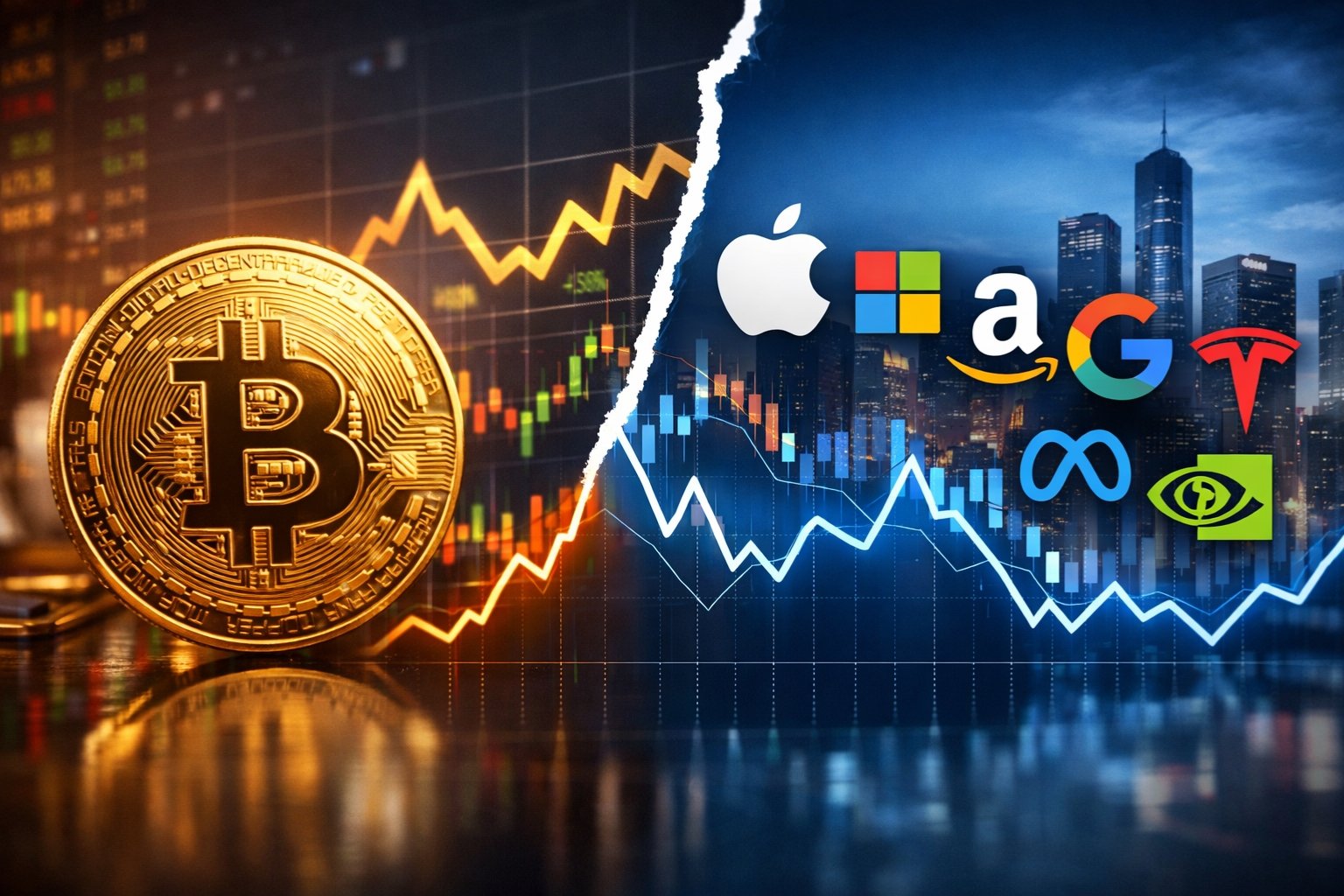

Bitcoin crashed 36% from its peak while the Nasdaq barely flinched, dropping just 8%. That divergence in late 2025 shattered a correlation that had defined crypto trading for two years. Investors who treated Bitcoin like a leveraged tech play got blindsided, while those watching correlation coefficients saw the fracture coming.
Understanding how correlated Bitcoin is to the Magnificent 7 matters because it determines whether Bitcoin belongs in your tech allocation, your hedge bucket, or both. The answer just got complicated.
The Historical Correlation Between Bitcoin and Magnificent 7 Stocks
Through 2024 and most of 2025, Bitcoin moved with tech stocks like they shared the same heartbeat. Standard Chartered research showed Bitcoin was almost always more correlated to the Nasdaq than to gold in the short term, behaving less like digital gold and more like a high beta version of your favorite tech giant.
The numbers backed this up. After President Trump’s January 2025 inauguration, Bitcoin’s volatility adjusted behavior looked similar to Nvidia’s, the AI darling that dominated Magnificent 7 returns. When Nvidia surged on earnings, Bitcoin often followed. When the Nasdaq pulled back, Bitcoin amplified the move downward.
Wall Street analyst John Roque put it bluntly in February 2026: “It’s all one trade. It was all one trade in 2024 and 2025.” His charts showed the Magnificent 7, software stocks, and Bitcoin tracking each other with eerie precision through their autumn 2025 peaks before synchronized weakness set in.
Why Bitcoin Tracked Tech Stocks
The correlation made intuitive sense. Digital asset treasury companies targeted the same investor group focusing on the Magnificent 7, creating overlapping capital flows. When institutions felt bullish about innovation assets, money flowed into both camps. Risk on sentiment lifted all boats.
The January 2024 spot Bitcoin ETF launches turbocharged this dynamic. Trading Bitcoin became as seamless and cost-effective as trading other Mag 7 stocks, removing friction that once separated crypto from traditional equities. Suddenly, the same portfolio managers clicking buy on Nvidia could add Bitcoin exposure with equal ease.
Macroeconomic conditions reinforced the link. Both Bitcoin and high growth tech stocks thrive in loose monetary environments and suffer when the Federal Reserve tightens. They react similarly to liquidity conditions, inflation expectations, and broader risk appetite shifts. For most of 2024 and 2025, they danced to the same macro music.
The Mag 7B Experiment: Replacing Tesla with Bitcoin
Standard Chartered took the correlation question seriously enough to run a thought experiment. What if Bitcoin actually belonged in the Magnificent 7 instead of just correlating with it?
What Standard Chartered Discovered
The bank created a hypothetical index called Mag 7B, swapping Tesla out and Bitcoin in among Apple, Microsoft, Nvidia, Amazon, Alphabet, and Meta. Starting from Bitcoin’s December 2017 all-time high near $20,000 to avoid biasing the analysis, Mag 7B outperformed the original Mag 7 index by about 5%.
The volatility findings surprised skeptics. Mag 7B showed lower volatility than Mag 7 in every single year of the analysis, averaging nearly 2% less volatile. Bitcoin didn’t increase portfolio risk as feared. It actually dampened it while boosting returns.
The risk adjusted metrics sealed the case. Mag 7B achieved an information ratio of 1.13 versus 1.04 for the traditional index. The information ratio measures excess return per unit of risk, and higher is better. Bitcoin delivered more bang per volatility buck than Tesla.
By market cap, Bitcoin ranked sixth in the Mag 7B index, ahead of Tesla. Not a speculative sideshow. A legitimate member of the mega cap club.
The Volatility Comparison
Bitcoin’s reputation as an unhinged volatility monster doesn’t match current reality. Over the last two years, Bitcoin proved less volatile than Netflix, with realized volatility averaging 46% on a 90 day timeframe versus Netflix’s 53%.
Recent data shows Bitcoin maturing. Bitcoin’s historical volatility was lower than some Magnificent 7 stocks, registering below Nvidia’s 50% and Tesla’s 63%. Charles Schwab analysts noted it wasn’t significantly different from silver futures at 38%.
The broader market comparison reveals Bitcoin isn’t an outlier. Bitcoin recently exhibited lower historical annualized volatility than 33 of the approximately 500 companies in the S&P 500. In October 2023, it was less volatile than 92 S&P 500 stocks using 90 day realized figures.
Context matters for the deeper drawdowns. Over the past three years, Bitcoin’s deepest decline was 50%, while Tesla dropped 54% and Nvidia fell 37%. Looking at five year spans including the 2022 bear market, Bitcoin’s 77% peak to trough decline exceeded Tesla’s 74% and Nvidia’s 66%, but not by the margin most assume.
The 2025 Correlation Breakdown
Then everything changed.
When the Relationship Fractured
October 10, 2025 marked the turning point when Bitcoin experienced a flash crash while the Nasdaq barely flinched. The crypto market, overloaded with leveraged long positions, suffered cascading forced liquidations. Bitcoin’s decentralized, globally liquid structure meant it reacted violently to crypto specific dynamics that had zero impact on traditional equities.
The divergence intensified through autumn and winter. Bitcoin fell as much as 36% from its October all-time high while the Nasdaq saw a maximum drawdown of only 8%. By December, the split was undeniable.
The 20 day correlation coefficient between Bitcoin and the Nasdaq 100 hit negative 0.43, marking the fourth time in five years the two assets moved into negative territory. Bitcoin sat 27% below its all time high while the Nasdaq traded just 2% below its record, a stark illustration of decoupling.
The Magnificent 7 kept climbing on AI momentum and strong earnings. Bitcoin kept falling on crypto specific headwinds. The “one trade” thesis shattered.
What Caused the Divergence
Capital fled Bitcoin through the new ETF on-ramps that had connected it to traditional markets. US Bitcoin ETFs recorded $3.5 billion in net outflows during November 2025 alone, approaching the February record of $3.58 billion. BlackRock’s IBIT, the largest with $68 billion in assets, saw an unprecedented $2.2 billion in redemptions.
The November 2025 liquidation event totaled $19 billion, exposing how leveraged the crypto market had become. When forced selling hit, it cascaded through crypto derivatives markets while equity markets remained stable. The leverage unwind was a crypto problem, not a tech stock problem.
Institutional capital rotated elsewhere, with long-term Bitcoin holders who accumulated positions before and after the 2025 halving event beginning to take profits. Post halving profit taking, reduced speculative interest, and trader exhaustion created selling pressure independent of broader market sentiment.
The AI narrative pulled institutional money toward Nvidia, Microsoft, and other Magnificent 7 names building the infrastructure for the next computing paradigm. Bitcoin, meanwhile, navigated regulatory uncertainty, on chain dynamics, and crypto specific catalysts that mattered less to equity investors.
What This Means for Investors
The correlation breakdown forces a strategic rethink.
The Dual Nature Hypothesis
BlackRock compared Bitcoin’s risk profile to the Magnificent 7 stocks and recommended investors allocate 1% to 2% to Bitcoin. The asset manager’s December 2024 research suggested this allocation brings a similar risk profile to holding these mega cap tech names.
Standard Chartered argued Bitcoin can serve as both a hedge against traditional finance risks and as part of tech allocations. This dual purpose positioning matters because it expands Bitcoin’s potential investor base beyond just crypto believers or tech enthusiasts.
The institutional thesis rests on Bitcoin playing multiple roles. In risk on environments with strong tech performance, Bitcoin can amplify returns. During traditional finance stress events like the March 2023 Silicon Valley Bank collapse, Bitcoin can provide an uncorrelated hedge. The flexibility makes it attractive for sophisticated portfolios.
Michael Saylor’s Strategy (formerly MicroStrategy) exemplifies this multi purpose approach, though with vastly more concentration than institutional guidelines suggest. The company’s aggressive Bitcoin accumulation created returns that dwarfed traditional treasury management while maintaining leverage ratios that terrified conservative investors.
Is This Decoupling Permanent?
History suggests caution before declaring victory for either camp. Previous negative correlation periods in July 2021, September 2023, and August 2024 all aligned with significant Bitcoin lows. Each time, the negative correlation marked a turning point before Bitcoin recovered.
The August 2024 instance came during the yen carry trade unwind, pushing Bitcoin down to roughly $49,000 before marking a local bottom. September 2023’s negative correlation appeared when Bitcoin traded just below $30,000, followed by a rally to $40,000 by year end. The pattern suggests negative correlation often precedes bottoms, not permanent structural shifts.
Expert opinions split on permanence. Benjamin Grolimund from Flipster noted that historically, post rate cut cycles like 2019 and 2020 saw Bitcoin’s beta to equities fall sharply as the narrative shifted from tech adjacent assets to digital gold.
Shane Molidor from Forgd captured the transitional moment: “Bitcoin is clearly traded as a risk asset at times, but it’s slowly exiting that category”. The shift from purely risk on behavior to something more nuanced could take years to fully materialize.
The fundamental drivers remain distinct even when prices correlate. Bitcoin’s supply is fixed and halving driven. It has no earnings, no CEO, no board making strategic pivots. The Magnificent 7 companies optimize for shareholder value, invest in R&D, make acquisitions, and respond to competitive threats. These different value drivers could eventually reassert themselves.
How to Navigate Bitcoin’s Correlation in Your Portfolio
Correlation isn’t destiny, but ignoring it is expensive.
Track the Right Metrics
The 20 day correlation coefficient with the Nasdaq gives you real time signals about whether Bitcoin is trading with or against tech stocks. When it turns negative like December 2025, historical patterns suggest watching for potential bottoms rather than chasing further downside.
ETF flow data matters more post 2024 than ever before. Monthly inflows and outflows from Bitcoin ETFs tell you whether institutional capital is rotating toward or away from crypto exposure. The November 2025 outflows signaled trouble before price fully reflected the shift.
Volatility comparisons help size positions appropriately. When Bitcoin’s realized volatility drops below 50% as it did in late 2023, it can handle larger allocations in risk managed portfolios. When volatility spikes above 60%, position sizing should shrink accordingly.
On chain indicators provide crypto specific context that correlation metrics miss. Exchange balances, holder profitability, and network activity reveal supply demand dynamics independent of Nasdaq movements. These matter more when correlation breaks down.
Portfolio Positioning Strategies
If correlation reasserts itself and Bitcoin starts tracking tech stocks again, treat it as a tech allocation proxy with higher beta. Size it smaller than individual Magnificent 7 holdings given the amplified volatility. BlackRock’s 1% to 2% guidance provides a reasonable starting point for most portfolios.
If decoupling continues and Bitcoin trades independently, it functions as a true diversifier. This potentially justifies maintaining or even increasing allocation since it’s providing uncorrelated returns rather than duplicating existing tech exposure. The key is ensuring the independence persists across market cycles, not just during crypto specific drawdowns.
Risk management requires acknowledging Bitcoin still carries higher volatility than established Magnificent 7 names even as that gap narrows. A 2% allocation to Bitcoin will impact portfolio volatility more than 2% to Microsoft. Run the numbers for your specific portfolio rather than copying institutional frameworks designed for different risk tolerances.
Rebalancing discipline becomes crucial when correlation fluctuates. When Bitcoin surges during high correlation periods, it can quickly exceed target allocations. When negative correlation drives Bitcoin down while tech stocks rally, mechanical rebalancing forces buying low and selling high across both asset classes.
Bitcoin’s correlation to the Magnificent 7 just fractured after two years of lockstep movement. Whether this marks Bitcoin’s evolution into an independent asset class or just another cyclical bottom before correlation reasserts itself will determine how you should position it. The data suggests watching correlation coefficients closely and adjusting as the relationship shifts, because treating Bitcoin as permanently correlated or permanently independent both carry risks the market will eventually punish.