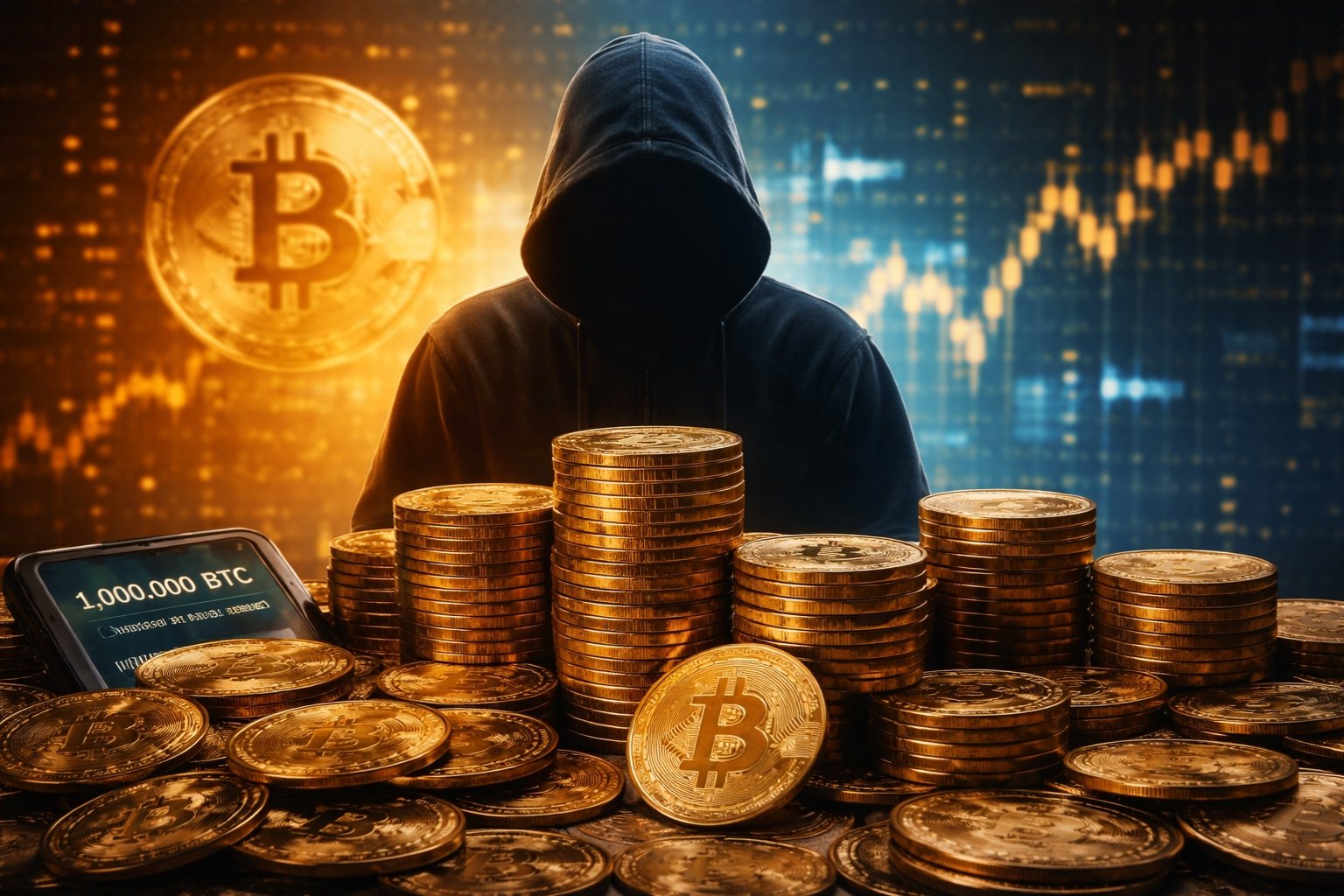

Satoshi Nakamoto owns approximately 1 million BTC, worth over $100 billion at current market prices. These coins represent roughly 4.8% of Bitcoin’s total 21 million supply and haven’t moved since 2010. Nobody knows if Satoshi can still access them, but their permanent inactivity has become one of crypto’s most powerful symbols.
The Numbers: 1 Million Bitcoin Worth Over $100 Billion
The consensus estimate places Satoshi’s holdings at around 1 million BTC. Some analyses suggest a range between 600,000 and 1.1 million, but the 1 million figure remains the most widely accepted by researchers.
At Bitcoin’s current price, this fortune exceeds $100 billion, making Satoshi one of the wealthiest individuals on paper. The calculation is straightforward: Satoshi mined approximately 22,000 blocks during Bitcoin’s first year of operation, from January 2009 through mid-2010.
Each successful block back then awarded 50 BTC as a mining reward. This was before Bitcoin’s first halving event in 2012, which cut block rewards in half. Simple math: 22,000 blocks multiplied by 50 BTC equals roughly 1 million Bitcoin.
These coins sit across thousands of different wallet addresses, most containing exactly 50 BTC from individual block rewards. What makes this fortune truly remarkable is its complete dormancy. Zero outgoing transactions. Zero movements. Zero signs of life for over 15 years.
How We Know: The Patoshi Pattern Explained
We can estimate Satoshi’s holdings because blockchain data is transparent and permanent. Every transaction, every block, every mining reward gets recorded forever. But identifying which early addresses belonged to Satoshi required detective work.
Cryptographer Sergio Demian Lerner cracked this puzzle by discovering what’s now called the Patoshi Pattern. This forensic analysis identified a unique mining signature that appeared consistently across Bitcoin’s earliest blocks.
The pattern revealed several technical fingerprints. Mining nonces showed identical characteristics across thousands of blocks. Block timing followed consistent intervals suggesting a single dominant miner. The technical signatures matched too precisely to be coincidental.
This wasn’t guesswork. Lerner analyzed the raw blockchain data and found one miner producing the overwhelming majority of early blocks while Bitcoin had almost no other participants. That dominant early miner was almost certainly Satoshi, keeping the network alive when nobody else cared.
The most famous Satoshi address is 1A1zP1eP5QGefi2DMPTfTL5SLmv7DivfNa, which mined the genesis block on January 3, 2009. That address now holds about 104 BTC, including the original 50 BTC reward plus donations sent by Bitcoin enthusiasts over the years. Interestingly, those original 50 BTC from the genesis block are technically unspendable due to how Satoshi coded that first transaction.
Here’s the crucial distinction: we can identify addresses that likely belong to Satoshi through blockchain forensics, but we cannot prove who controls the private keys. The coins are visible. The owner remains invisible.
Why These Coins Have Never Moved
Two main theories explain Satoshi’s untouched fortune, and both are credible.
Theory one: Lost access. Satoshi might have lost or deliberately destroyed the private keys. Early Bitcoin had minimal value, so losing access wouldn’t have felt catastrophic at the time. Maybe hard drives failed. Maybe precautions weren’t taken seriously when each Bitcoin was worth pennies instead of tens of thousands of dollars.
Theory two: Intentional preservation. Satoshi chose to never touch these coins as a philosophical statement. By abandoning this fortune, he proved Bitcoin didn’t exist to enrich its creator. He vanished completely in 2011, walking away from billions to ensure no single person could ever claim ownership over the network.
The evidence supports theory two more strongly. Satoshi’s final communications showed deliberate withdrawal, not accidental disappearance. He handed development responsibilities to others, cleaned up loose ends, then vanished on purpose.
This act transformed Bitcoin from “Satoshi’s project” into a truly decentralized network belonging to everyone and no one. The untouched coins prove the system works exactly as designed: trustless, permissionless, free from founder control.
Consider what didn’t happen. Satoshi never cashed out during Bitcoin’s rise from $0.01 to $1, from $100 to $1,000, from $10,000 to $100,000. He watched his creation succeed and chose principle over profit at every milestone.
What This Means for Bitcoin’s Supply and Price
Satoshi’s dormant million Bitcoin creates artificial scarcity beyond Bitcoin’s programmed 21 million cap. The effective circulating supply is lower than commonly assumed because these coins will likely never enter the market.
This matters for every Bitcoin holder. Reduced supply with constant or growing demand pushes prices higher. Satoshi’s coins sitting permanently frozen makes everyone else’s Bitcoin slightly more valuable.
The market psychology is equally important. These untouched coins serve as ongoing proof that Bitcoin has no puppet master pulling strings behind the scenes. No founder dumping on retail investors. No central authority manipulating price. Just code and consensus.
But what if Satoshi’s coins suddenly moved?
Even a small transfer, say 10,000 BTC, would trigger immediate market chaos. Traders would panic. Price volatility would spike. Some analysts estimate potential drops of 10 to 15 percent as markets digest the shock. The movement would dominate headlines and spark endless speculation about Satoshi’s identity and intentions.
However, the long-term impact is debatable. After the initial shock wore off, Bitcoin would likely stabilize. The fundamentals wouldn’t change. The technology would still work. One wallet moving coins doesn’t break the network.
Blockchain monitoring shows zero activity for 15 years. No partial transfers. No test transactions. No signs of preparation. Either those keys are gone forever, or Satoshi possesses superhuman patience.
The Bigger Picture: Satoshi’s Fortune in Context
Satoshi Nakamoto is Bitcoin’s largest individual holder, but how does this compare to other major players?
Coinbase holds approximately 973,000 BTC across its cold storage wallets, mostly customer funds held in custody. BlackRock’s Bitcoin ETF controls around 782,000 BTC. Binance manages roughly 646,000 BTC. The United States government seized and still holds about 328,000 BTC from various criminal cases.
Satoshi’s estimated 1 million BTC puts him at the top, but with a critical difference. Exchanges and institutions hold Bitcoin on behalf of others. Satoshi’s coins belong to nobody, locked away from markets forever.
No other technology founder sits on comparable unrealized wealth. Jeff Bezos sold Amazon shares. Mark Zuckerberg cashed out Facebook stock. Steve Jobs profited from Apple’s success. Bill Gates sold Microsoft equity throughout his career.
Satoshi did the opposite. He invented a revolutionary technology, earned a massive fortune, and chose to walk away completely. That decision carries more weight than the dollar value itself.
These coins prove Bitcoin’s core promise: a financial system where no individual holds ultimate power. The creator himself submitted to the network’s rules and disappeared into the crowd.
A fortune that belongs to no one is a currency that belongs to everyone. That’s not marketing copy. That’s 15 years of blockchain evidence showing coins worth over $100 billion sitting untouched while their creator stays silent. The mystery endures, but the message is clear: Bitcoin works exactly as designed, with or without Satoshi.